Code-Based Snow Load Assessment for Roof Design, Failure Investigation, and Claims

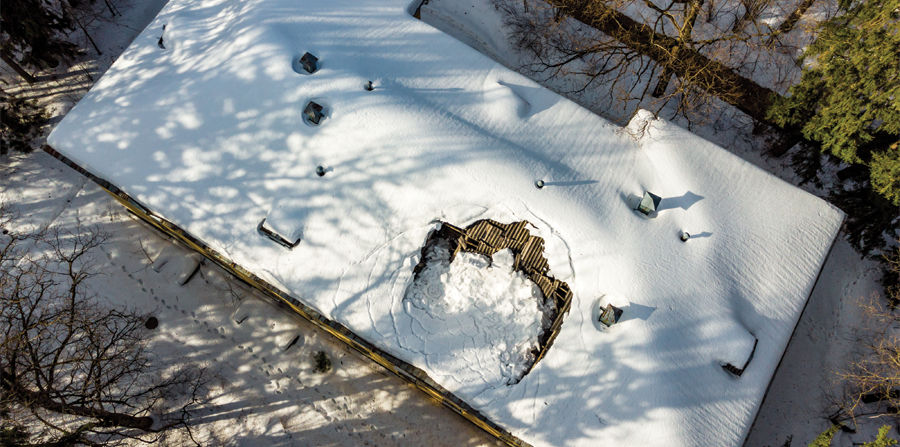
Winter roof failures are often attributed to “excessive snow,” but that conclusion must be grounded in code-defined snow loads, not visual roof depth. A defensible snow load assessment requires three essentials: the correct code benchmark, accurate on-site snow measurements, and disciplined application of building code methodology. Without this framework, conclusions about causation, liability, and insurance coverage risk become subjective and difficult to defend.
At the core of both roof design and forensic investigation is the distinction between ground snow load and roof snow load. Building codes establish ground snow values by location and provide methods to convert them into roof design loads using exposure, importance, slope, and thermal factors. This creates a consistent benchmark to evaluate whether a failure resulted from loads exceeding design assumptions or from deficiencies in design, construction, or maintenance.
Why Ground Snow Load Drives Accurate Conclusions
A common mistake in failure investigations is relying on roof snow depth as a proxy for load. In reality, snow loads are driven by density and depth, not depth alone. Fresh snow may be light, while compacted or rain-saturated snow can weigh several times more. Two roofs with identical snow depth can carry dramatically different loads depending on weather conditions and snowpack characteristics.
Roof loads are also rarely uniform. Wind redistribution, drifting at parapets or step roofs, and rain-on-snow events create localized loading conditions that cannot be captured by simple visual observations. This is why code-based ground snow values, paired with site-specific density measurements, are the only reliable basis for comparison.
Field Verification: Turning Weather into Structural Demand
A disciplined investigation starts with timely field data collection. Ground snow samples should be taken from representative, undisturbed areas and tested for density by measuring depth and water equivalent. Multiple samples reduce variability and provide a defensible average. Weather station data can support findings but must be used cautiously, accounting for microclimates such as lake-effect or elevation differences.
Rain-on-snow events require particular attention. Rainfall can significantly increase snowpack weight within hours, but its impact depends on whether water infiltrates or drains. Proper analysis applies code-prescribed rain load adjustments, rather than assumptions about saturation.
Aligning Measured Loads with Code Requirements
The key analytical step is comparing the measured ground snow load at the time of failure with the code-prescribed ground snow design value for that location and building classification. This requires identifying the governing code edition and whether the structure was designed under prescriptive provisions or engineered design.
- If measured loads exceed code values, the event may qualify as an extreme or “excessive” snow condition.
- If loads are below code thresholds, investigators must examine alternative causes, including structural deficiencies, construction errors, or maintenance issues.
Critically, roof measurements alone should not be back-calculated into design loads, as drift and unbalanced loading invalidate uniform assumptions.
Beyond Load: Common Causes of Roof Failure
Many roof collapses occur even when snow loads are within design limits. In these cases, the root cause often lies in gaps between design intent and real-world conditions, including:
- Design limitations or misuse of prescriptive provisions for complex roof geometries
- Construction deficiencies, such as missing connections or inadequate bracing
- Unengineered modifications, including cutting trusses or removing load-bearing elements
- Moisture and maintenance issues, such as ice damming, poor drainage, or corrosion
Engineered wood trusses, for example, are highly reliable when properly designed and installed, but their performance can degrade due to handling damage, environmental exposure, or field alterations that disrupt load paths.
Implications for Insurance Claims and Liability
For insurers, adjusters, and forensic experts, a code-anchored workflow provides clarity and defensibility:
- Establish the correct ground snow design benchmark
- Measure actual site conditions (density, depth, and rainfall)
- Apply the appropriate code provisions and load cases
- Evaluate structural capacity, condition, and modifications
This approach separates trigger (snow event) from cause (failure mechanism), enabling accurate coverage decisions and targeted subrogation. It also avoids overreliance on photos or anecdotal evidence, which cannot quantify structural demand.
Building More Defensible Outcomes
Ultimately, effective snow load assessment is about replacing assumptions with measurable, code-aligned data. By focusing on ground snow loads, proper field verification, and code-based analysis, professionals can distinguish true overload events from preventable structural vulnerabilities.
This not only strengthens forensic conclusions but also supports better design practices, reduces disputes, and improves resilience in future projects.
Our experts are ready to help.